



RS Aero
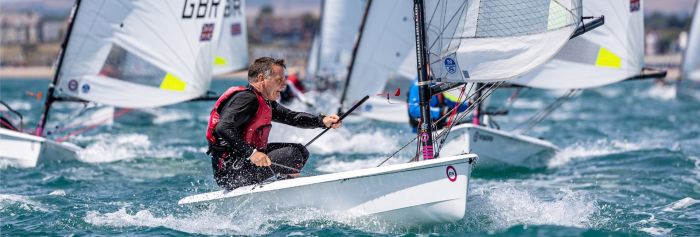
The RS Aero is today's best-selling modern single-hander, and at Proasail.com we understand why: RS Sailing rates it as the most technically advanced boat in its sector, and on the water it pairs a lively feel with straightforward handling.
- SKU
- AER-CB
Incl. VAT:
€10,357.96
Excl. VAT:
€8,560.30
Incl. VAT:
Excl. VAT:
1
Crew
up to 160
Crew weight (kg)
33
Hull weight (kg)
GRP and carbon fibre
Hull material
1.4
Beam (m)
4
Length (m)
5.2 / 6.3 / 7.4 / 8.9
Sail area (m²)
Joy
- Minimal weight that you appreciate ashore and that turns into pure feel on the water.
- Sheer exhilaration afloat: that is the hallmark of the RS Aero.
- Onto the car roof rack without help (or with a youngster's), rigged in minutes and launched with ease: going sailing is that simple.
World Sailing International Class
- The best-selling modern single-hander, with a fleet growing at speed worldwide.
- A class racing calendar that keeps on expanding.
- Its own World Championship since 2017.
- One-design racing, with the community spirit that RS is known for.
Hull size
- RS Sailing's trials settled the length at 4 metres: enough for a heavy helm to sail comfortably, yet compact enough for smaller sailors to launch and recover the boat without a struggle.
- At 1.4 m beam, it travels on an ordinary car roof rack.
Chines
- RS Sailing opted for a hard-chine hull: the helm gets a greater reserve of stability.
- Offwind, the chine throws the spray clear and gives the boat dynamic stability.
- Being flatter, the hull panels are built from standard PU foam sheets and the core bond weighs less: a core that has to follow tight curves soaks up more resin in its cuts or in its honeycomb structure.
- Amidships, the chine sits just below the waterline, which has several welcome consequences:
- With a 35 kg sailor aboard, the waterline beam, and with it the hull's form stability, is virtually the same as with a heavier helm.
- If the helm is heavier, neither the waterline beam nor the wetted surface changes appreciably.
- The RS Aero's low mass means less inertia to pull against when moving inboard in a lull or an adverse shift; the flatter hull and the buoyancy of the chine compensate for it.
- A small lip along the chine does two jobs: it cuts the drag generated by spray and it acts as a datum for placing the computer-cut foam panels precisely during construction.
Fine bow
- The hull combines three zones with different jobs: a fine entry that performs upwind, midship sections that provide the stability and a comparatively wide transom.
- RS Sailing refined the transom shape so the boat planes bow-up, rather like the trim tabs on the stern of a powerboat.
- Plumb bows are common on dinghies and on box-rule or rating-formula yachts. For this one-design, RS Sailing chose a raked bow: here the measured waterline length dictates nothing, and in addition:
- The topsides gain flare over the forward 20% of the hull, giving more reserve buoyancy and better manners in waves.
- It simplifies the hull lay-up: more efficient construction and more consistent parts in series production.
- And, above all, it lets the hulls stack, one of the RS Aero's most valued qualities. Function rules here, not styling fashion.
Gunwale design
- The RS Aero is a relatively narrow boat, so RS Sailing made the most of its width with a modern approach: over the aft half, the gunwale runs parallel to the centreline. The advantages:
- The helm gets maximum righting moment wherever they hike, further forward or further aft.
- After a capsize, the topsides provide little buoyancy: the boat sits lower in the water and the board is easier to reach.
- The kink in the deck-edge line just ahead of the cockpit makes a fine bow possible without widening the overall beam or the forward topsides.
- Coming alongside a RIB or a pontoon is easier.
- On the roof rack there is more room to lash the two mast sections along the hull.
- It stores or travels resting on one side without any fuss.
- Hull and deck are joined with a conventional gunwale. After almost ten years of using the flush "biscuit tin" joint on the RS Elite, RS Sailing chose a U-section gunwale for the RS Aero for these reasons:
- It forms a carbon laminate "frame" around the boat that spreads the rig loads through a light, efficient structure. Righting the boat from inverted is quicker and safer. Upwind and close reaching, the ride is noticeably drier and more pleasant. And holding the boat when launching and recovering, especially in waves, takes far less effort.
Flat-panel deck
- Wherever the design allowed, the deck used flat panels: the load paths stay straight, with structural corners, and weight is kept to a minimum.
- Three requirements guided the choice of deck profile, after trialling numerous variants: security when running in a breeze, good support to push off from in a roll tack and, above all, comfort when hiking. RS Sailing also resisted the styling temptation to cut the deck away at the transom: sitting there is useful when bearing away in extreme conditions.
Mast foot
- During construction, a vertical pin fixes the position of the mast foot in the hull, so mast rake and position are identical on every RS Aero.
- Once the boat is built, the pin is removed and the hole serves as the mast step drain.
- The bottom of the mast step carries a stainless steel wear plate.
Stackable
- RS Aeros stack on top of one another: the underwater hull of one boat sits precisely on the deck of the one below.
- Three stacked boats fit on a conventional road trailer base, separated only by padded blocks; no double or triple trailers needed.
- Thanks to this stacking, a 40-foot container carries more than 20 RS Aeros, with the corresponding savings in transport costs and carbon footprint to dealers and regattas.
Construction
- Every detail of this simple shape is there to cut weight and lower the cost of construction:
- The flatter panels of the chined hull are built from standard PU foam sheets, with less resin weight in the core bond.
- The deck also uses the chine principle: its edges add structural stiffness to the shape, without a single extra gram.
- A simple shape means fewer build hours.
- Epoxy resin, chosen for its high strength and low water absorption.
- Woven glass fibre throughout the hull.
- Carbon fibre in the most heavily loaded areas: hull and deck around the mast foot, the hiking area of the deck, the whole gunwale perimeter and the transom.
- The combination of minimal weight and an epoxy resin system with high elongation to break (crack resistance) has made the RS Aero a remarkably durable boat.
- So light that one person can carry it up the beach by the top of the daggerboard and the boom. On a launching trolley, even less effort.
- Youth sailors and smaller women lift it onto the car roof rack by themselves.
- Shape and symmetry are under control from the outset: the moulds were CNC machined.
Dynamic rig in four sizes (RS Aero 5, 6, 7 and 9)
- RS Sailing started from one premise: several sail areas were needed to cover the whole range of crew weights. Hence the four rigs, RS Aero 5, 6, 7 and 9, at 5.2, 6.3, 7.4 and 8.9 m².
- The rigs were developed with enough control to flatten the mainsail completely and twist off the head of the sail upwind, so the heeling moment drops. That allows more sail area to be carried, a clear advantage downwind and in light winds.
- Developed with a world-leading carbon fibre tube manufacturer, the four rigs share the top mast section and boom, while the lower sections have radically different stiffness. That difference in bend and stiffness at deck level keeps the boat balanced with any sail, without resorting to a permanently pre-bent lower section for the smallest one.
- Even with the smallest sail, the sail area to hull weight ratio clearly beats that of most existing hiking single-handers, because the hull weighs so little. That is why an RS Aero 5 responds with the same sensitivity that makes the rest of the range so exciting.
- The largest rig weighs 5.5 kg less than its aluminium alloy equivalent, and a state-of-the-art production method guarantees tight control of stiffness and weight.
- Two-piece carbon mast with track and halyard for the mainsail, rather than a sleeved sail: rigging in a breeze is far simpler and it allows full-length top battens.
- The rig sits well forward, with a generous distance between the mast and the centre mainsheet point: less sheet load, easier gybes and none of the snagging risk of a transom-led mainsheet.
Sails
- This is where styling demands clash hardest with the RS Aero's performance requirements.
- A Mylar sail cannot follow the wide range of bend of such a responsive carbon mast, in different winds and on different points of sail: the cloth lacks bias (diagonal) stretch, because Mylar film does not stretch in any direction.
- So RS Sailing settled on a high-denier Dacron with a low filler content, a durable and very easy-to-use cloth.
Foils
- The RS Aero has a vertical daggerboard, designed for simplicity of use.
- The board comes out of a CNC-machined mould that fixes the profile to millimetre precision, and has a modern section: little drag downwind and enough lift to resist leeway upwind.
- Its unusual profile has an explanation: the board fills the case in the hull up to the knuckle on the leading edge, so the slot is sealed and drag is kept to a minimum. When raised, the part still in the water is narrower and more efficient, and the heeling moment also drops.
- The tip, tapered below the knuckle, reduces tip losses at the end of the foil.
- There is evidence that a knuckle on the leading edge, like the one on the RS Aero's board, stabilises the flow, something also seen on birds' wings.
- So that the water maintains laminar flow and no efficiency is lost, both the board and the rudder blade end in a fine trailing edge.
- The rudder blade, developed during testing, combines a low-drag section with an extremely effective surface.
- The rudder stock, purpose-designed and made from high-quality alloy, is pared down to the essentials.
- Ashore, the blade can be swung right up to vertical; afloat it is held firmly at any angle.
Fit-Out
- The fit-out is simple, provides the rig controls you need and lets you get the boat ready to sail in no time.
- The toe strap, on the centreline, is padded for comfort and adjusts to hiking style and sailor size.
- As options, RS offers purpose-designed carbon parts that are as functional as they are good-looking: brackets for TackTick or Velocitek electronics, a GoPro camera mount and the carbon tiller extension.
Detalles
| Crew | 1 |
|---|---|
| Crew weight (kg) | up to 160 |
| Hull weight (kg) | 33 |
| Hull material | GRP and carbon fibre |
| Beam (m) | 1.4 |
| Length (m) | 4 |
| Sail area (m²) | 5.2 / 6.3 / 7.4 / 8.9 |
| RS Aero 5 | RS Aero 6 | RS Aero 7 | RS Aero 9 | ||
|---|---|---|---|---|---|
| Designer | Jo Richards / RS Sailing | ● | ● | ● | ● |
| Length | 4 m (13'2") | ● | ● | ● | ● |
| Beam | 1.4 m (4'7") | ● | ● | ● | ● |
| Hull weight | 33 kg (73 lb) | ● | ● | ● | ● |
| Max crew weight | 160 kg (353 lb) | ● | ● | ● | ● |
| Sail area RS Aero 5 | 5.2 m² (56 ft²) | ● | |||
| Sail area RS Aero 6 | 6.3 m² (68 ft²) | ● | |||
| Sail area RS Aero 7 | 7.4 m² (80 ft²) | ● | |||
| Sail area RS Aero 9 | 8.9 m² (96 ft²) | ● | |||
| Hull construction | Epoxy | ● | ● | ● | ● |
| Mast | Two-piece carbon fibre, with track and halyard | ● | ● | ● | ● |
| Boom | Carbon fibre, with centre mainsheet | ● | ● | ● | ● |
| Daggerboard | Epoxy composite with foam core | ● | ● | ● | ● |
| Rudder blade | Epoxy composite with foam core | ● | ● | ● | ● |
| Rudder stock | Cast aluminium, custom design | ● | ● | ● | ● |
| Toe strap | Padded and adjustable | ● | ● | ● | ● |
| Control lines | Split and cleated on both side decks | ● | ● | ● | ● |
| TackTick bracket | Carbon fibre | ○ | ○ | ○ | ○ |
| Velocitek bracket | Carbon fibre | ○ | ○ | ○ | ○ |
| GoPro bracket | Carbon fibre | ○ | ○ | ○ | ○ |
● standard · ○ optional
| Feature | RS Aero 5 | RS Aero 6 | RS Aero 7 | RS Aero 9 |
|---|---|---|---|---|
| Sail area | 5.2 m² | 6.3 m² | 7.4 m² | 8.9 m² |
| Recommended sailor weight | 35-55 kg | 45-70 kg | 65-85 kg | 85-110 kg |
| Recommended age | Youth | Youth and lighter adults | Adults | Heavier adults |
| Recommended level | Beginners and youth racing | Progression and racing | Racing | Racing and maximum performance |
| Performance | Maximum control and ease | Balance of control and power | High performance | Maximum power and speed |
| Ideal use | First races and lighter sailors | All-round sailing | National and international racing | Experienced sailors and light-wind conditions |